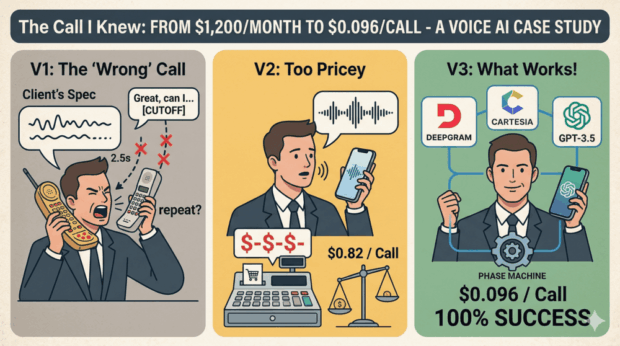
A client came to us with a specific technical requirement: build a phone ordering AI using Twilio Voice API and webhooks. Standard stack. Clear spec.
(more…)Category: Uncategorized
Engineering Trust in the Age of DORA: Exit Strategy and Technical Sovereignty in the Artificial Intelligence Era

Trust in financial institutions has changed its foundation. Previously, regulators and customers relied on capital adequacy, liquidity buffers, and reputation. Today, however, digital operational resilience increasingly defines whether an institution deserves trust.
This shift explains why the European Union adopted the Digital Operational Resilience Act, Regulation (EU) 2022/2554. The regulation closes the era in which financial institutions could treat technology as a largely self-regulated domain. Regulators no longer accept disaster recovery plans that exist only in documentation. Instead, they expect institutions to prove, through engineering, that they can survive severe disruptions affecting third-party infrastructure.
(more…)US CLOUD Act vs. EU DORA: Navigating the Digital Sovereignty Minefield

For the last decade, much of Europe’s financial sector lived with a convenient contradiction.
On one side, banks and insurers pushed hard into digital transformation, migrating critical workloads into US hyperscalers like Microsoft Azure, AWS, and Google Cloud. The reasons were obvious: scale, maturity, global reliability, and fast access to advanced AI tooling.
On the other side, Europe’s regulatory environment kept tightening. GDPR raised the bar on data protection. Supervisors increasingly focused on third-party risk. And now, with DORA in force since January 2025, the conversation has shifted from “compliance paperwork” to operational resilience: can you prove critical functions remain available, controlled, and auditable under stress, including geopolitical stress?
(more…)RAG vs. Hallucinations: How We Engineer “Defensible Answers” for Regulators

Executive summary: the engineering problem of the DORA era
Rolling out large language models (LLMs) in European financial services creates a basic clash: GenAI is probabilistic by design, while financial regulation demands deterministic control, evidence, and repeatability. As institutions moved toward full enforcement of the Digital Operational Resilience Act (DORA) in January 2025, the industry ran into a very practical engineering requirement: convert “creative” generative capabilities into defensible outputs that can survive scrutiny from internal audit, the European Central Bank (ECB), and national competent authorities.
(more…)Why 90% of GenAI Pilots Will Fail DORA Audits in 2025: An Exhaustive Analysis of Article 28 and the AI Supply Chain
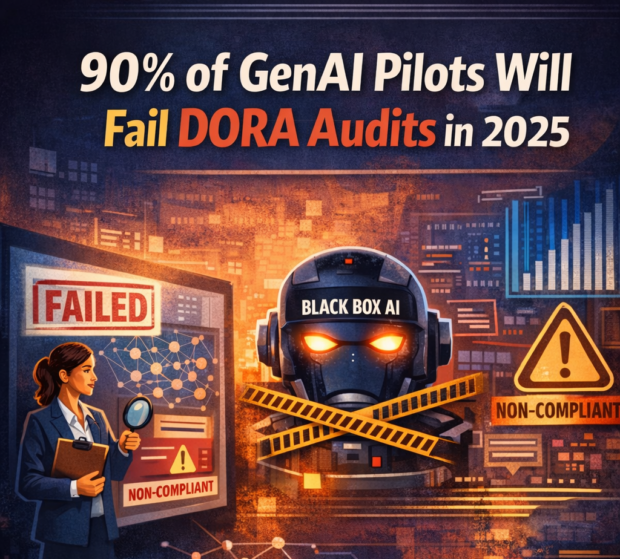
The convergence of the Digital Operational Resilience Act (DORA) and the explosive adoption of Generative AI (GenAI) represents a singular event in the history of financial technology regulation. As the January 17, 2025, compliance deadline passes, the European financial sector faces a stark reality: the architectural paradigms currently driving GenAI innovation are fundamentally incompatible with the operational resilience mandates of DORA. While financial institutions have spent the last two years aggressively deploying Large Language Models (LLMs) to gain competitive advantages in customer service, fraud detection, and code generation, the regulatory framework governing these deployments has shifted from a focus on data privacy (GDPR) to a relentless focus on supply chain resilience, substitutability, and deterministic control.
(more…)The Ultimate DORA Vendor Assessment Checklist for AI Solutions

The entry into force of Regulation (EU) 2022/2554, better known as the Digital Operational Resilience Act (DORA), marks a real shift in how EU financial institutions must think about risk. From 17 January 2025, the job is no longer just “manage capital well”. It’s also: prove your ICT can withstand disruption in a world of escalating threats.
At the same time, banks are rolling out generative AI (GenAI) and large language models (LLMs) into processes that are increasingly business-critical: customer support, fraud detection, compliance support, credit decisioning, internal knowledge search, and more.
(more…)How to Build a Custom AI Voice Agent: A Practical, Engineering-Centric Guide
Custom AI voice agents are no longer experimental tools — they are becoming foundational components in modern business infrastructure. When engineered correctly, they don’t just automate conversations; they execute tasks, integrate with backend systems, enforce compliance, and operate at scale with low latency and full observability. Unlike off-the-shelf solutions that trade control for convenience, custom-built agents offer long-term cost efficiency, adaptability, and strategic ownership. This guide breaks down the architecture, implementation process, integration patterns, cost structure, QA methodology, and compliance considerations necessary to deploy production-grade voice automation that aligns with your business goals and operational constraints.
(more…)Real-Time Voice Agents: Why Static Voice Bots Are Already Obsolete

Most traditional voice bots still operate like automated phone menus: you speak, the system waits, then it replies. That kind of rigid, turn-based interaction made sense when AI was slow and brittle. But in 2025, with the emergence of streaming architectures and multimodal LLMs, the game has changed completely.
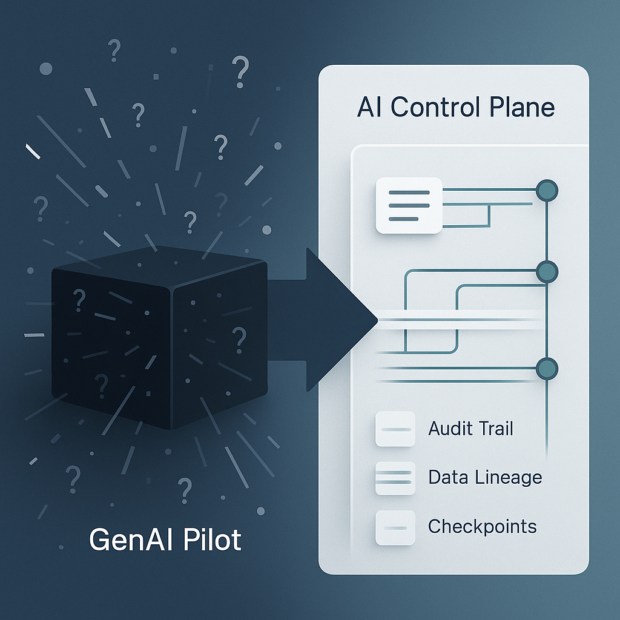
(more…)2026: GenAI in financial services after DORA. Why “quick pilots” no longer pass, and why Intellectum Lab AI Control matters
Introduction: 2025 happened, but the real questions started in 2026
From 17 January 2025, DORA (the Digital Operational Resilience Act) stopped being “an IT regulation on paper” and became day-to-day reality for EU financial entities. By 2026, most organisations have already felt it in practice: early reviews, first audit cycles, tabletop exercises, board reporting. The conversation is no longer about impressive demos. It’s about control.
(more…)